
From chatbots to agents
The report describes a shift from AI that answers questions to systems that carry out tasks. It considers the implications for Poland’s business services, accounting, IT and the way companies are organised.
Chapter 9 · p. 63AGI Poland / AI / economy / society
A report on how artificial intelligence could change Poland’s economy, work and social life. It combines a diagnosis of Poland’s position with the author’s proposed roadmap: from infrastructure and skills to taxation, ownership and citizens’ share in the benefits of AI.
AGI means artificial general intelligence. The report considers increasingly capable AI and different scenarios for its effects.
Inside the report
The author examines the transition through three connected questions: who will do the work, who will receive the value it creates, and what will give people security and a sense of purpose.
The report describes a shift from AI that answers questions to systems that carry out tasks. It considers the implications for Poland’s business services, accounting, IT and the way companies are organised.
Chapter 9 · p. 63It explores a scenario in which productivity grows while wages and public revenue lag behind. This raises questions about funding public services, taxing labour and other sources of revenue.
Chapter 3 · p. 11A dedicated chapter examines work’s role in identity, relationships and feeling needed. Alongside material support, the report proposes places where people can meet, learn and act together.
Chapter 12 · p. 72The report’s central idea
The author proposes using productivity gains to reshape institutions and distribute the benefits more widely. AI adoption is linked to citizen ownership, public services and economic security. This is the starting point for the report’s roadmap.
The author’s proposals
The report sets out a proposed transition for Poland over 2026–2040. Each pillar addresses a different condition for using AI to support shared prosperity.
Domestic computing capacity, energy supply and a Polish Data Bus connecting public registers. The proposed model combines access to global technology with control over its applications and data.
Pillar I · p. 32A proposed shift of some taxation from labour to land value, alongside possible revenue linked to AI infrastructure. The report discusses land value tax (LVT), valuation and revenue allocation across levels of government.
Pillar II · p. 38Individual learning accounts, practical retraining and employee participation in AI adoption. Trade unions are given a role in shaping the transition through their knowledge of how work is actually done.
Pillar III · p. 41AI cooperatives, employee shareholding and a Data Trust representing collective interests in data. These proposals aim to give citizens a stake in the ownership and income generated by automation.
Pillar IV · p. 45A proposed productivity dividend combined with public services and institutions that support community. The report connects the question of livelihoods with questions of purpose, agency and belonging.
Pillar V · p. 52These are the author’s proposals, presented with dependencies and a timeline. They are not adopted government policy or active NEOTOPIA programmes.
Concrete examples
The One Person Company model: a person sets the direction and coordinates AI agents carrying out tasks. The report considers how this could change entrepreneurship and what support it would require.
One Person Company · p. 63A proposal to use AI tools for audiovisual production by creators in smaller towns. It connects culture and local entrepreneurship with the possibility of reaching international audiences.
Polish Hollywood 2.0 · p. 66Read the full report
The full publication develops these themes through economic debates, risk scenarios, case studies and recommendations for public institutions. Available in Polish and English.
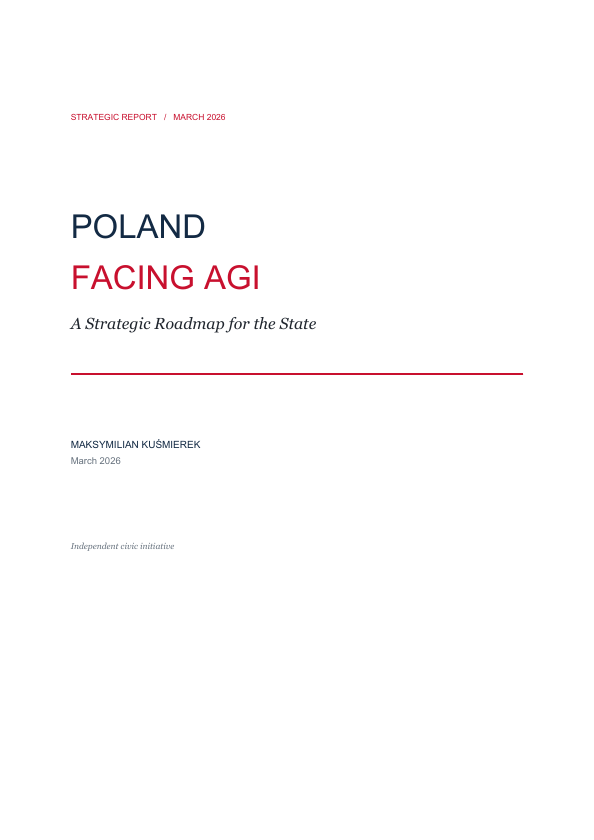
This is the founder’s earlier work, by Maksymilian Kuśmierek.
The publication includes scenarios and the author’s proposals. Selected fiscal calculations require corrections.
What comes next
We are preparing a new edition under the foundation. We are seeking expertise, independent review and financial support. The scope of work and publication date remain to be agreed.
Next project